Friday, June 22, 2012

Five Positions Of The Pentatonic Minor Scale

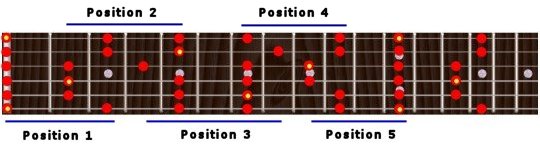
The five positions of pentatonic minor for guitar and bass. Below you will see the full version of the E pentatonic minor scale, showing where each position should be played in E pentatonic minor on the guitar. You can also see where all of the root notes are on the full diagram of E pentatonic minor.


* Note that the positions overlap, for instance position two is simply the top half of position one mated with the bottom half of position 3.


All of these positions fit together perfectly and will always be in the same order that they are here. That means that they must always be positioned together as they are and their relation to each other will never change. To play this pentatonic minor scale in any key other than E, you would have to slide the whole note diagram up or down the neck, moving all the positions together.


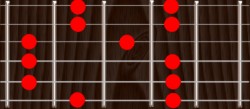
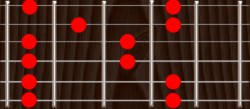
This will show you the individual positions.


Position 1:
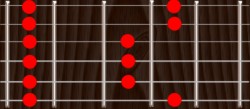


Position 2:


Position 3:


Postion 4:


Position 5:
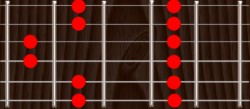


Now we can move on to start learning how to use this in your playing.


Pentatonic Scales - Pentatonic Minor And Pentatonic Major

Pentatonic scales are five note scales that are fairly easy and are an excellent introduction into the world of scales. Then we will cover phrasing to start soloing and improvising with the pentatonics. Pentatonic scales are great for improvising as they are fairly easy and work with almost anything.


The Pentatonic Minor Scale

This scale is often called the "blues scale"This scale is a fairly simple introduction to scales and how scales work. It is a very commonly used scale and can be found in many popular songs, especially in classic rock, blues, hard rock, and more. Because this scale is so commonly used it is the perfect scale for you to start with.

in this course we will learn most scales in the key of E:


E pentatonic minor will be the pentatonic minor scale played in the key of E, which means E will be our root note. That means that the whole scale and the way you use it will be centered around the E note. We will cover that in much more detail when we get to "phrasing"

in the diagram below you will see the entire E Pentatonic Minor scale shown as it will look on your guitar neck. The notes you would play are marked with red dots, and the "root notes" (E notes) are marked as red dots with yellow dots in the center.


The Chromatics Lesson


This is all about all the notes that are available on any normal instrument, as well as learning to identify them properly. There are twelve notes in any key, and these 12 notes are the chromatics.


chromatics - These are all twelve (12) of the notes in an octave.
A - A# - B - C - C# - D - D# - E - F - F# - G - G#
* After the G# would be the octave note where it all just starts over again with A

Naturals And The Non-Naturals

There are two main groups of notes in any octave. The naturals are simply all the notes with normal letter names with no sharps or flats in their names. The non-naturals are the notes that have sharps or flats in their names.

Naturals - These are the notes with normal letter names. There are seven of them.
A - B - C - D - E - F - G
Non-Naturals - These are the notes with sharps or flats in their names. There are five of them.
A# - C# - D# - F# - G#
Together, the (7) naturals and (5) non-naturals make up the twelve chromatic notes. (7+5=12)

Tuning Up Your New Guitar Strings

There are a few different methods to tune your guitar,


A-440 Tuning Reference - this is the industry standard for tuning modern instruments. The "A" stands for an A note, and 440 refers to the speed of the vibration that leads to what we consider a perfect A note. The reason is that all sound is vibration, and the speed of these vibrations produces the pitch of the sound. Frequency (or vibration speed) is commonly referred to as Hertz, or Hz. 


As you tighten your guitar strings they will vibrate faster producing higher tones. When you loosen them, they vibrate slower producing a lower tone. The idea is to match your A string perfectly to the A440 reference tone.


Tuning Reference Tools - we used to use a standard tuning fork to tune guitars and other instruments, which is a metal bar that splits into two bars that vibrate at 440hz and produce a reference note when struck.


Digital tuners that read the frequency have gotten very accurate and quite inexpensive as well, so that will be the right tuning equipment choice for almost everybody.


Comparative Tuning - this is a method of comparing the tune of one string to another, and is useful for tuning if you can get one string in tune using a reference note. It is also quite useful for checking your tune quickly and easily.


Or you can use some site to tune your guitar in standard, etc.
here are some sites 

The Guitar Neck Diagrams

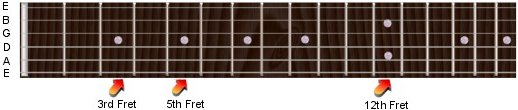
What you will see when looking at the diagram below is the "low E" string (the fattest one) on the bottom, and the "high E" (the thinnest one) on top. This should be easy to tell as the string sizes are visible on the neck.


You will see dots on the fretboard marking where the notes should be played. They will be in various colors and will mean various things.


Bass players can use the exact same diagrams as the guitar diagrams, using only the bottom four strings (low E, A, D, G).

Guitar Chord Chart


Thursday, June 21, 2012

Guitar World

Welcome to Guitar World,

         I created this blog, to enhance ourselves, helps others, know what world of guitar is..

Here, we will make ourselves better in playing guitar,
guitar theories, guides, scales, arpeggios, building up guitar speed and many many more..,
Please support

Join us in Groups in facebook
http://www.facebook.com/groups/419185041459374/

Need authors :)
message your e-mail address ..

I hope soon, this blog will get better :)
Thank you!


Guitar is Not a thing, it is an extension of myself, extension of us, it is who i am, it is who we are :)